Reps in Reserve and RPE: How to Autoregulate Your Working Weight
Stop chasing a 1RM percentage that changes daily. Here's how to use reps in reserve and RPE to pick the right weight by feel, plus where your gut goes wrong.
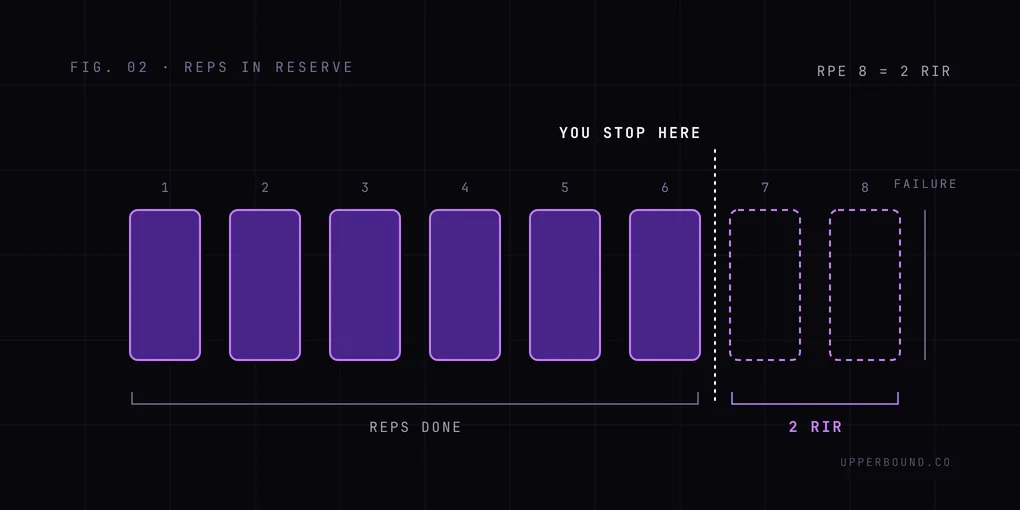
A percentage chart assumes your one-rep max is a fixed number. It isn’t. Your max on a bad-sleep, high-stress Tuesday can be five percent lower than the number you tested a month ago, and the chart has no idea. Reps in reserve (RIR) fixes that by anchoring your weight to today instead of to a spreadsheet. You pick a load, leave a set number of reps in the tank, and let the weight float with how strong you actually are that day. Here’s how to run it, and where your own judgment will lie to you.
Key Takeaways
- RIR measures how many more reps you could have done before failure. RPE 10 means zero in the tank; RPE 8 means two left.
- Autoregulating load by RPE beats fixed percentage-based programming for strength: in a 2025 network meta-analysis, RPE-based loading ranked well above percentage charts (PMC, 2025).
- Your RIR guess gets sharper the closer you are to failure, and most lifters leave more reps in the tank than they think. Calibrate against that.
What is RIR, and how is it different from RPE?
RIR is the number of reps you could still do at the end of a set before hitting failure. RPE, rating of perceived exertion, is the effort score that maps onto it: on the resistance-training scale, RPE 10 is a true grinder with zero reps left, RPE 9 is one left, RPE 8 is two, and so on down. They’re two ways of saying the same thing. I tend to think in RIR because “two reps left” is more concrete than “a nine,” but use whichever number sticks in your head.
The point of either one is to describe effort relative to your failure point on this set, not relative to a percentage of a max you tested weeks ago. That’s the whole reason it travels better than a percentage chart.
Why bother? Doesn’t a percentage chart already work?
Percentage charts work right up until your readiness moves, which is constantly. The chart locks your weight to a tested 1RM, but your true max drifts day to day with sleep, stress, and accumulated fatigue, so “80% for five” can feel like an easy three-in-the-tank one week and a near-miss the next. RIR closes that gap by reading the day instead of the calendar.
The evidence backs the swap. In 2025, a network meta-analysis on autoregulated resistance training found that RPE-based loading produced greater maximal-strength gains than fixed percentage-based programming, with the percentage approach ranking last among the methods compared (Autoregulated resistance training for maximal strength enhancement, Sports Medicine - Open, 2025). That doesn’t make percentages useless. It just means the “objective” number on the chart is quietly less objective than it looks.
I ran 5/3/1 for three or four months, and since it works off a percentage of a training max, the failure mode showed up fast. On a good week I’d hit the prescribed reps, feel like I had three or four left in the tank, and move on because the percentage said so. I left progress on the table. On a bad week I’d grind that same percentage into the floor and call it discipline. RIR would have told me to add load on the first day and back off on the second. The chart told me to do the opposite of both.
How do you actually rate a set?
You rate a set by how hard the last rep was to complete and how many more you could have grudgingly made. The most reliable tell is bar speed: as you approach failure, the bar slows down whether you want it to or not, and that slowdown tracks effort closely. If the last rep moved at roughly the same speed as the first, you had several in reserve. If it ground to a near-stop, you were within a rep of the wall.
This isn’t just a feel thing. When researchers validated the RIR-based RPE scale, movement velocity tracked reported effort almost perfectly in trained lifters, with an inverse correlation of about negative 0.88 between speed and RPE (Zourdos et al., JSCR, 2016). So if you want to sanity-check your gut, watch the bar. Slow grinder, high RPE. Snappy rep, low RPE. Your eyes and your rating should agree. Whatever number you settle on, write it down next to the set, because a logged RIR is the input every later decision reads. For what to track in your log and what to skip, that’s a guide of its own.
How to pick your weight with RIR, week to week
Pick a target RIR for the work, then adjust load until the set lands on it. For most hard strength and hypertrophy work, a target of one to three reps in reserve is the useful range: hard enough to drive adaptation, far enough from failure that you can recover and repeat it. Here’s the loop in practice:
- Set a target. Say your top set today is meant to be three-in-the-tank (RPE 7 to 8).
- Take your best guess at the weight. Use last week’s load as the starting point.
- Rate the set honestly. If it felt like five reps left, the weight was too light. Add load next set or next week. If you barely made the last rep, it was too heavy. Drop it.
- Let the number float. The weight that hits three-in-the-tank will be higher on a good week and lower on a rough one. That’s the feature, not a bug.
Notice this is the same measure-adjust-repeat loop the volume side runs, just pointed at load instead of set count. Intensity and volume are the two levers you have, and RIR is how you read the intensity one day to day. For the volume side of the same loop, see the case for autoregulating volume, and for how much volume you actually need, start from the landmarks.
The catch: your RIR guess is wrong in predictable ways
Your RIR estimate is not a clean instrument, and it fails in patterns worth knowing. The big one: accuracy improves the closer you get to failure. Research on proximity to failure found that intraset RIR predictions were most accurate within a rep or two of the wall and drifted badly when lifters guessed from far away (Proximity to Failure Influences Accuracy of RIR, JSCR, 2019). Predicting “five in the tank” at the start of a long set is mostly a coin flip. Predicting “one more” at the end is reliable.
Two more patterns. First, most lifters underestimate, meaning they leave more reps in the tank than they claim, so an honest “two left” is often really three or four, especially early in a training career. Second, experience matters less than people assume. One analysis found that on machine-based single-joint exercises, training experience didn’t significantly change RIR accuracy, though estimates did get better on sets under about twelve reps (Remmert et al., RIR accuracy across training status, Perceptual and Motor Skills, 2023).
The practical translation: trust your RIR read most on heavy, low-rep top sets taken close to failure, and trust it least on light, high-rep back-off work where you’re guessing from a distance. If you’re new, assume you have a rep or two more than you feel, and occasionally take a set to true failure just to recalibrate where the wall actually is. Your gut is a sensor that drifts. Check it on purpose.
Frequently Asked Questions
Is RPE the same as reps in reserve?
They’re two scales for the same idea. RPE rates effort from 1 to 10; RIR counts reps left before failure. On the resistance-training scale they map directly: RPE 10 is 0 RIR (failure), RPE 9 is 1 RIR, RPE 8 is 2 RIR. The 2016 validation study built the RPE scale specifically around reps in reserve (Zourdos et al., JSCR, 2016).
What RIR should I train at?
For most hard sets, aim for one to three reps in reserve. That’s close enough to failure to drive strength and size, but far enough back that you can recover and repeat the work across a week. Save zero-RIR true failure for occasional calibration or the last set of an exercise, not your default, since it costs disproportionately more fatigue.
Do RIR estimates work for beginners?
Roughly, yes, with a caveat. One analysis found training experience didn’t significantly change RIR accuracy on single-joint machine work (Remmert et al., 2023). But beginners tend to underestimate badly, stopping with three or four reps left while reporting one. If you’re new, train a touch closer to failure than feels right, and test the real limit now and then.
Should I ever train to true failure?
Sometimes, deliberately, not by default. A set to true failure (0 RIR) tells you exactly where the wall is, which recalibrates every estimate after it. The cost is fatigue that lingers and eats into the next session’s volume. Use failure as a measurement tool every few weeks, mostly on isolation work, and keep your main lifts a rep or two short of it.
The bottom line
Reps in reserve turns your working weight into something responsive. Instead of obeying a percentage of a max that’s already stale, you pick a target effort, leave a known number of reps in the tank, and let the load rise or fall with how strong you are that day. The guess is imperfect, and it’s worst exactly when you’re far from failure, so calibrate it against bar speed and the occasional honest grinder. Do that, and the weight on the bar starts telling the truth about today instead of repeating a number you wrote down last month.
Sources
- Autoregulated Resistance Training for Maximal Strength Enhancement: A Systematic Review and Network Meta-Analysis, retrieved 2026-06-17, https://pmc.ncbi.nlm.nih.gov/articles/PMC12336695/
- Zourdos et al., Novel Resistance Training-Specific Rating of Perceived Exertion Scale Measuring Repetitions in Reserve, Journal of Strength & Conditioning Research, retrieved 2026-06-17, https://journals.lww.com/nsca-jscr/fulltext/2016/01000/novel_resistance_training_specific_rating_of.31.aspx
- Proximity to Failure and Total Repetitions Performed in a Set Influences Accuracy of Intraset Repetitions in Reserve-Based Rating of Perceived Exertion, Journal of Strength & Conditioning Research, retrieved 2026-06-17, https://pubmed.ncbi.nlm.nih.gov/30747900/
- Remmert et al., Accuracy of Predicted Intraset Repetitions in Reserve in Single- and Multi-Joint Resistance Exercises Among Trained and Untrained Men and Women, Perceptual and Motor Skills, retrieved 2026-06-17, https://pubmed.ncbi.nlm.nih.gov/37036795/