How Much Should You Train This Week? The Case for Autoregulating Volume
Your program assumes recovery is constant. It isn't. Here's how to autoregulate weekly training volume using four signals and a simple feedback loop.
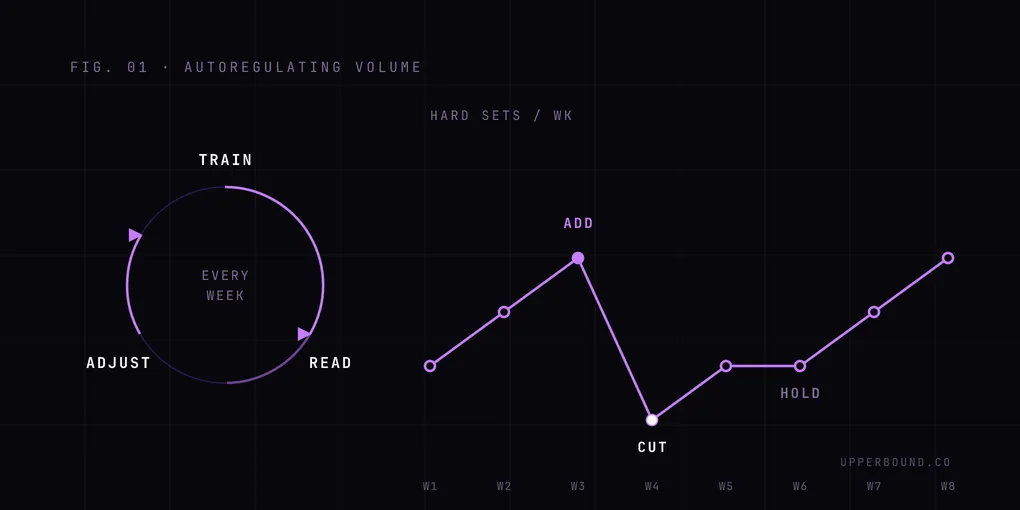
Most programs hand you a fixed number of sets and quietly assume your body will cooperate on schedule. It won’t. The set count that built muscle in week two can turn into junk volume by week six, and the program has no idea, because a spreadsheet can’t feel how you slept. Autoregulating volume is the fix: instead of obeying the plan, you let a handful of recovery signals get a vote in how many sets you actually do. Here’s how I think about it, and how you can run the same loop.
Key Takeaways
- Recovery isn’t a constant. It’s the sum of your sleep, your stress, and how hard you’ve been pushing, and a fixed set count ignores all three.
- Autoregulated training beats rigid percentage-based programs for strength: in a 2025 network meta-analysis, autoregulating methods ranked far above fixed loading (PMC, 2025).
- Read four signals weekly (performance, joint load, readiness, and yes, fun), then add sets, hold, or cut. That’s the whole game.
What does autoregulating volume actually mean?
Autoregulation means adjusting your training based on how you’re recovering right now, not how a coach guessed you’d recover three months ago. Most of the research is about autoregulating intensity, using RPE or reps-in-reserve to pick today’s weight. Autoregulating volume is the same idea pointed at a different variable: how many hard sets you do per muscle per week.
And honestly, volume is the variable that deserves it more. Intensity mostly sorts itself out. If the weight’s too heavy, you miss the rep and you know immediately. Volume is sneakier. You can grind out five sets that you had no business doing, feel productively wrecked, and call it a good session, when really you just dug a hole you’ll pay for next week. Nobody misses a rep on set four and thinks “ah, that was the junk one.”
The case for doing this at all is reasonably settled. In 2025, a systematic review and network meta-analysis on autoregulated resistance training found that autoregulating methods (adjusting load and volume to daily readiness) produced greater maximal-strength gains than fixed percentage-based programming, with the percentage-based approach ranking dead last (Autoregulated resistance training for maximal strength enhancement, Sports Medicine - Open, 2025). That doesn’t prove your specific Tuesday needs two fewer sets. It just means the rigid plan isn’t the safe default people assume it is.
If you want the intensity side of the same loop, I wrote a separate guide to autoregulating your working weight with reps in reserve.
Why a fixed set count quietly stops working
A fixed set count stops working because recovery isn’t a constant. It’s made up of moving parts. Roughly, your recovery is the sum of your sleep quality, your overall life stress, and how hard you’ve been pushing in the gym. A set count in January is not the same set count in March, and the volume that worked in week one of a block is rarely the right volume in week six.
Believe me, I’ve tested the rigid approach. A lot. I ran Stronglifts, GSLP, and 5/3/1, and they all worked, as long as my life was stable and my responsibilities were few. The moment work got heavy or sleep got short, the same program that felt great started feeling like a tax. Some sense of accomplishment, sure, followed by fatigue I couldn’t explain and the occasional tweak that put me on the shelf for a week. I’ve been training seriously for about four years and still consider myself a beginner, but even a beginner notices the pattern: when you bolt a fixed plan onto a life that isn’t fixed, the plan wins and you lose.
A training program shouldn’t take over your entire life. In my opinion it should be complementary to it: still demanding, still pushing results, but flexible enough to bend on the week your kid is sick or your sleep falls apart. The rigid version can’t bend, so it breaks somewhere. Usually that somewhere is you.
If you’re not sure where your starting set count should even sit, set it from established volume landmarks like MEV, MAV, and MRV first, then let the signals move it from there.
The four signals I read before changing volume
Before I add or cut sets, I check four signals. Three of them have decent evidence behind them. The fourth is mine, and I’ll flag it clearly so you can take it or leave it.
Performance. Are your working weights and reps still climbing, or have they gone flat for two sessions running? This is the loudest signal and the hardest to argue with. If the bar isn’t moving, more volume is rarely the answer.
Joint and tendon load. Do you have pain that isn’t normal muscle soreness or DOMS? Sore quads are fine. An elbow that aches before you’ve touched a barbell is not. That kind of nagging is your tissues asking you to back off, and stacking volume on top of it is how a niggle becomes a layoff.
Readiness. Sleep quality, resting heart rate, HRV if you track it, or just the plain feeling that today’s warm-up weights feel heavier than they have any right to. You don’t need a wearable for this. You need to be honest about whether the bar feels fast or feels like a punishment.
Fun. This one’s controversial, and I want to be clear: it’s a personal observation, not science. But the stretches where I’m genuinely enjoying my training are reliably the stretches where I can push the hardest and recover fine. When the gym starts feeling like a chore I have to survive, my numbers are usually already sliding, and fun just tells me before the spreadsheet does. Treat it as a tiebreaker, not a law.
Look at it like this: if a good personal trainer asked you about your sleep, your aches, your energy, and whether you actually want to be there, they’d be naive to ignore the answers. Your program shouldn’t either. Sleep carries the most weight of any readiness input, so it’s worth knowing how sleep affects your strength before you write off a rough night.
So how do you adjust sets week to week?
You turn the four signals into a simple weekly decision, then change volume by a little, not a lot. Here’s the rule I use. Score each signal green or yellow at the end of the week:
- Two or more green: add a set or two to the muscle groups that feel best. Small steps.
- One yellow, rest green: hold. Repeat last week’s volume and let it ride.
- All of them red: cut volume 30 to 40% for a week and let the signal recover.
That last one isn’t a deload you earned by suffering. It’s a measurement telling you the dose got ahead of your recovery, and the smart move is to lower the dose, not white-knuckle through it.
One caveat on the readiness side, since it leans on your own judgment. Reps-in-reserve estimates (your sense of how many reps you had left) get sharper the closer you are to failure, and they get worse early in a set. Research on proximity to failure found that intraset RIR predictions were most accurate within a rep or two of failure and drifted badly when lifters guessed from far away (Proximity to Failure Influences Accuracy of RIR, JSCR, 2019). The original RIR scale validation showed the same thing: experienced squatters rated effort far more accurately than novices, with movement velocity tracking RPE almost perfectly in trained lifters (Zourdos et al., JSCR, 2016). Practical translation: trust your readiness read more on hard top sets than on easy back-offs, and trust it more the longer you’ve been lifting.
This volume loop sits on top of plain progressive overload, so make sure that base is solid before you start tuning sets.
Isn’t this just a deload with extra steps?
No, and the difference matters. A scheduled deload is calendar-driven: every fourth week you back off whether you need it or not, which means you sometimes throw away a great week and sometimes push through a terrible one. Autoregulating volume is signal-driven. You back off when the signals say back off, and you keep building when they say keep building.
Put plainly: a deload is penance you pay on a fixed schedule. Autoregulation is a thermostat. One reacts to the calendar, the other reacts to you. If your recovery happens to crater on a predictable cycle, the two will look identical, but most lives aren’t that tidy.
For the mechanics of an actual back-off, how much to cut, how long to hold it, and what it costs you, see when and how to deload.
Frequently Asked Questions
Is autoregulating volume only for advanced lifters?
No. Beginners get the cleanest results from straightforward linear progression, because they recover fast and adapt to almost anything. But the readiness read is easier with experience: the 2016 RIR validation found experienced lifters rated effort far more accurately than novices (Zourdos et al., JSCR, 2016). Start simple, layer this in as your progress slows.
Do I need an HRV device or a velocity tracker?
No. The four signals work fine with no hardware: performance is in your logbook, aches are in your joints, readiness is in how the warm-up feels, and fun is in your head. A wearable can sharpen the readiness signal, but it’s a nice-to-have, not a prerequisite. Don’t let gear be the thing that stops you from starting.
How is this different from a deload?
A deload is scheduled: you back off on a fixed timeline regardless of how you feel. Autoregulating volume is reactive: you cut sets only when your signals say recovery has fallen behind. They can produce the same week off, but one is driven by the calendar and the other by your actual state.
Can I autoregulate volume on a beginner program?
You can, but you mostly shouldn’t yet. Early on, the prescribed jumps work and breaking a record most weeks is normal. Autoregulation earns its keep later, when significant progress shows up monthly instead of weekly and a fixed set count starts costing you more than it gives.
The bottom line
You’re not following the plan. You’re running a feedback loop. The plan is a starting hypothesis (a reasonable guess at how much you can handle), and the four signals are the data that corrects it week after week. Performance, joints, readiness, and fun all get a vote, and when they vote together, you listen.
Rigid programs treat recovery as a constant because constants are easy to print on a spreadsheet. Your recovery isn’t a constant, and pretending otherwise is how good training quietly turns into junk volume. Read the signals, change the dose, repeat. That’s the whole loop, and it’s a better coach than any number you wrote down in January.
Sources
- Autoregulated Resistance Training for Maximal Strength Enhancement: A Systematic Review and Network Meta-Analysis, retrieved 2026-06-17, https://pmc.ncbi.nlm.nih.gov/articles/PMC12336695/
- Zourdos et al., Novel Resistance Training-Specific Rating of Perceived Exertion Scale Measuring Repetitions in Reserve, Journal of Strength & Conditioning Research, retrieved 2026-06-17, https://journals.lww.com/nsca-jscr/fulltext/2016/01000/novel_resistance_training_specific_rating_of.31.aspx
- Proximity to Failure and Total Repetitions Performed in a Set Influences Accuracy of Intraset Repetitions in Reserve-Based Rating of Perceived Exertion, Journal of Strength & Conditioning Research, retrieved 2026-06-17, https://pubmed.ncbi.nlm.nih.gov/30747900/