Sleep and Strength: The One Recovery Input You Can't Fake
A single bad night barely dents your top set. But a week of short sleep cuts testosterone 10 to 15 percent. Why you can't fake recovery, and what to do instead.
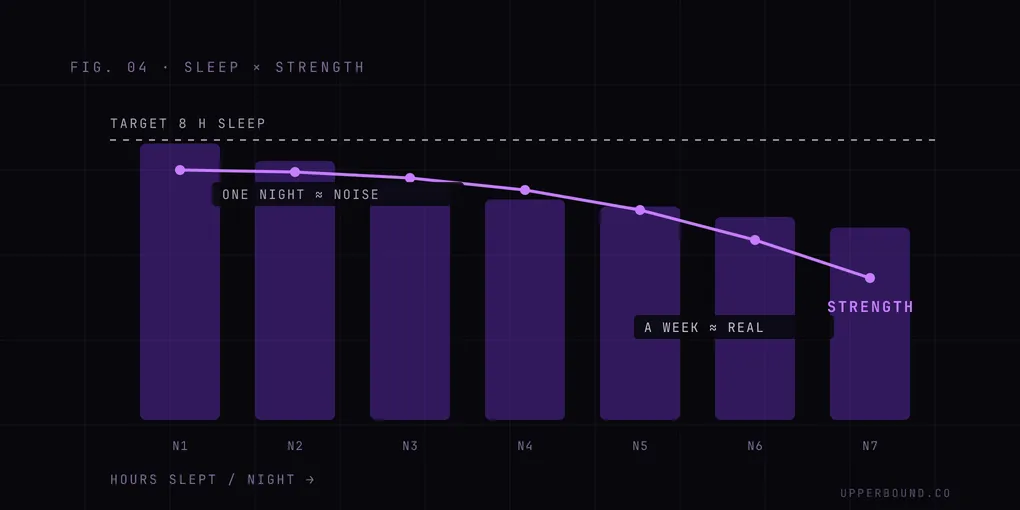
You slept five hours, you got out of bed on auto pilot, your eyes feel heavy, and now you’re standing in front of a loaded bar wondering if you should even bother. Some lifters treat a bad night as a write-off, either skipping the session or bracing for a missed lift. The truth is more useful than that. Your top set will probably hold up fine. I’ve hit PRs on five hours of sleep. What sleep actually controls is the recovery underneath the session, and that’s the part no amount of caffeine, creatine, or wearable tech can buy back. Here’s what the research says, and how to train around it.
Key Takeaways
- One bad night barely touches your max strength, but it raises how hard everything feels and shrinks how much volume you can handle.
- A week of short sleep cut daytime testosterone 10 to 15 percent in young men (Leproult & Van Cauter, JAMA, 2011). Stimulants mask that deficit, they don’t repair it.
- When sleep falls apart and you can’t fix it, lower the dose: trim volume and let recovery catch up.
Does sleep actually affect your strength?
Yes, but not the way most lifters fear. In a 2025 systematic review on sleep loss and muscle strength, maximal strength held up well after acute sleep deprivation, while several nights of restricted sleep in a row cut force output in multi-joint movements (Sleep and Breathing, 2025). The headline number on the bar is sturdier than your panic suggests. The recovery around it is not.
A one-rep max is a brief, maximal motor task, and those survive a rough night surprisingly well. The things that erode are the things you can’t see in a single top set: how hard the work feels, how many quality sets you can string together, and how well you bounce back for the next session. Strength training lives in that second category far more than the first.
What does one bad night actually change?
It changes the price, not the ceiling. After acute sleep loss, your top single is largely intact, but the same weight feels heavier, your reps before failure drop, and your appetite for volume falls off (Sleep and Breathing, 2025). You can still hit a heavy double. You just can’t back it up with the five hard sets you’d normally tolerate.
That matters because of how lifters read a session. The real risk after a bad night isn’t a missed PR you’d notice and respect. It’s grinding out junk volume at inflated effort, feeling productively wrecked, and calling it a good day when you actually just dug a hole.
I’ve trained seriously for about four years and still consider myself a beginner, but I’m pretty good at pattern recognition. In weeks where I missed a lot of sleep, my opening set still moved. It was set two and three that fell apart, the warm-ups that felt like working weight, the nagging sense that I was working harder for less. The bar wasn’t lying about my max. My body was telling me to do less and recover.
Why sleep cannot be replaced with stimulants and supplements
Because the things lifters reach for instead of sleep either mask the deficit or measure it. None of them restore it. That’s the entire case for treating sleep as the one input you don’t get to negotiate with. Using sleep sensors can be great, but still, they’re not a reason to skip a session or to plan on failing.
Caffeine masks it
Caffeine is great, I also experimented with pre-workout drinks loaded with 200mg of caffeine, or even more. It will definitely kick start your morning. It basically tells your body, “no you aren’t tired, you can do this”. However, the underlying sleep debt isn’t paid for, the hormones, tissue repair you skipped are all still there under that buzz.
Supplements don’t replace it
Creatine is the most evidence-backed supplement a lifter can take, and it still doesn’t substitute for sleep. It helps a rested body do slightly more. It does nothing for the recovery processes that short sleep shuts down. No powder on the shelf repairs muscle, restores hormones, or consolidates a motor pattern like sleep does.
A recovery score measures, it doesn’t decide
An HRV reading or a sleep score from your watch is useful information, but it’s a readout, not a remedy. The bigger risk is what the philosopher C. Thi Nguyen calls value capture: you start out caring about recovery, then drift into caring about the score, until chasing a perfect number quietly pulls you off the plan you actually came to train (Nguyen, The Economist, 2026). My personal opinion: one rough night or red sensor is noise, not a signal. A run of broken nights and sinking scores is a real signal worth acting on, but a single reading isn’t, and it’s a weak reason to skip a session.
What does short sleep cost you over weeks?
Stack bad nights and the small leaks become problematic. When young men slept five hours a night for a week, their daytime testosterone fell 10 to 15 percent, roughly the hit of aging 10 to 15 years (Leproult & Van Cauter, JAMA, 2011). Testosterone isn’t the whole strength picture, but it’s one of the levers chronic short sleep quietly lowers.
Injury risk moves too. In a study of adolescent athletes, those sleeping under eight hours a night were 1.7 times more likely to get hurt than those sleeping more (Milewski et al., Journal of Pediatric Orthopaedics, 2014). That’s a young population, so don’t read it as a fixed adult number. Read it as direction: less sleep, more breakdown, fewer sessions that actually happen.
Add the multi-joint force decline from consecutive restricted nights (Sleep and Breathing, 2025), and the chronic story is clear. A single bad night is a tax. A short-sleep month is a slow leak in everything that makes you stronger.
How much sleep do you actually need to keep getting stronger?
Seven to nine hours is the working floor, and the gains show up most when you climb out of a deficit. When Stanford basketball players extended their sleep toward ten hours a night, their sprint times dropped from 16.2 to 15.5 seconds and their shooting accuracy rose about nine percent, with faster reaction times on top (Mah et al., SLEEP, 2011). More sleep didn’t just prevent decline. It raised the ceiling.
So chase the hours, not a number on a dashboard. Total sleep time comes first, consistency second, and the fancy readiness metrics a distant third. If you’re sleeping six hours and optimizing your pre-workout, you’re tuning the radio while the engine’s low on oil. Fix the hours, and most of the recovery problems you were trying to supplement away get quieter on their own.
When you can’t fix your sleep, what should you change instead?
You change the training dose, because that’s the one thing still in your hands. Some weeks the sleep just isn’t there. A newborn, a deadline, a stretch of travel. You can’t fake the input, so the smart move is to stop pretending it’s normal and lower the demand to match.
Treat sleep as a readiness signal and let it vote on your volume. A one-word note on the night, logged alongside your training, is enough to explain a rough week when you read it back. On a wrecked week, cut sets rather than white-knuckling the full plan, which is exactly the loop laid out in the case for autoregulating volume. If the short sleep drags on across a whole block, that’s less a single bad week and more a sign you need a planned back-off entirely.
The mistake I made for years was holding the program fixed and hoping my body would catch up. It doesn’t. The plan is a guess at what you can recover from, and sleep is the biggest variable that guess ignores. When the input drops, drop the dose. You lose nothing real by training a little less on the weeks you’ve already lost the sleep that would let you train more.
Frequently Asked Questions
Does one bad night of sleep ruin your workout?
No. Maximal strength is resilient to a single night of poor sleep, so your top set will likely be fine (Sleep and Breathing, 2025). What suffers is perceived effort and how much volume you can handle. Train, but consider trimming a set or two rather than forcing the full plan.
Can caffeine replace sleep for lifting?
No. Caffeine can reverse much of sleep restriction’s hit to high-intensity performance (European Journal of Applied Physiology, 2025), but it masks the deficit rather than repairing it. Your hormones, tissue repair, and recovery are still impaired. It buys output for the session, not recovery for the week.
How many hours of sleep do you need to build muscle and strength?
Seven to nine hours is the floor for most lifters. The biggest gains appear when you move from a deficit into that range. Athletes who extended sleep toward ten hours improved sprint speed and accuracy (Mah et al., SLEEP, 2011), so more sleep can raise performance, not just protect it.
Does lack of sleep lower testosterone?
Yes. One week of sleeping five hours a night cut daytime testosterone 10 to 15 percent in healthy young men, comparable to aging a decade or more (Leproult & Van Cauter, JAMA, 2011). It’s one of several recovery and hormonal processes that chronic short sleep quietly suppresses.
The bottom line
You can spend a fortune on recovery theater. Powders, gadgets, a phone full of green scores. Sleep is the one input none of it replaces. A bad night won’t tank your top set, so don’t skip the session in a panic, but don’t kid yourself that caffeine or a supplement bought the recovery back either. They mask the deficit or measure it. Only sleep pays it down. Read your sleep honestly, and on the weeks it falls apart, change the training dose instead of pretending the input is fine. That’s the whole move.
Sources
- Implications of Sleep Loss or Sleep Deprivation on Muscle Strength: A Systematic Review, Sleep and Breathing, retrieved 2026-06-22, https://link.springer.com/article/10.1007/s11325-025-03413-0
- Leproult & Van Cauter, Effect of 1 Week of Sleep Restriction on Testosterone Levels in Young Healthy Men, JAMA, retrieved 2026-06-22, https://pubmed.ncbi.nlm.nih.gov/21632481/
- Caffeine Intake Reverses the Impairment of Sleep Restriction on High-Intensity Exercise Performance, European Journal of Applied Physiology, retrieved 2026-06-22, https://link.springer.com/article/10.1007/s00421-025-05888-x
- Mah et al., The Effects of Sleep Extension on the Athletic Performance of Collegiate Basketball Players, SLEEP, retrieved 2026-06-22, https://pubmed.ncbi.nlm.nih.gov/21731144/
- Milewski et al., Chronic Lack of Sleep is Associated With Increased Sports Injuries in Adolescent Athletes, Journal of Pediatric Orthopaedics, retrieved 2026-06-22, https://pubmed.ncbi.nlm.nih.gov/25028798/
- C. Thi Nguyen on Babbage: The dangers of obsessing over metrics, The Economist, retrieved 2026-06-23, https://www.economist.com/podcasts/2026/03/18/the-dangers-of-obsessing-over-metrics