How to Deload: When to Back Off and How Far
Most guides treat a deload as a fixed week on the calendar. A 2022 coach survey and a 2024 trial say otherwise: how much to cut, how long, and what backing off actually costs.
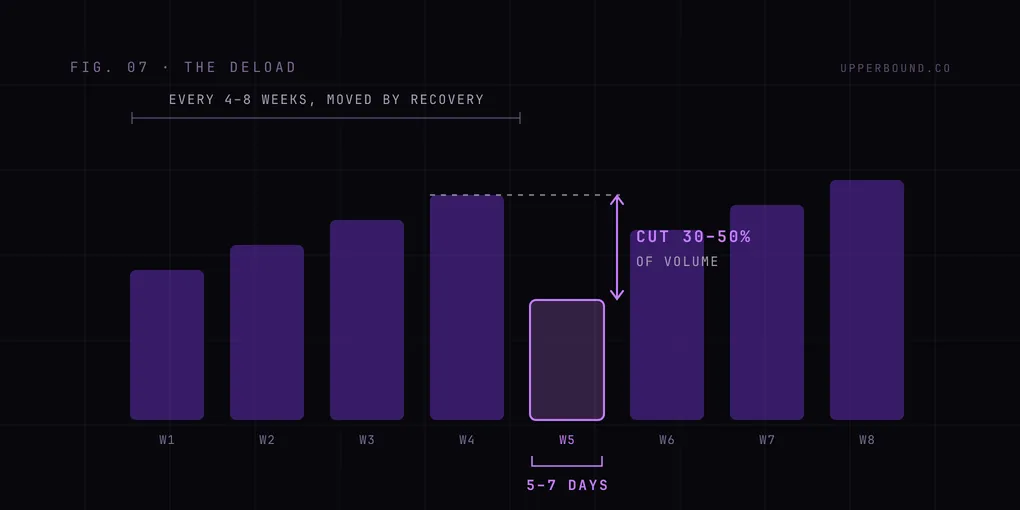
A deload is a smaller dose on purpose, not a rest week and not a punishment. Most guides treat it as a fixed appointment: every fourth week, back off, whatever your week actually looked like. The hub post on this site already made the case that a rule which never checks your real recovery is the wrong default. This one goes further: how much to actually cut, how long to hold it, what it really costs you, and why the coaches who program this for a living rarely pick one pure rule over the other.
Key Takeaways
- A deload is a short, deliberate drop in volume or intensity, not a full week off. A 2022 survey of strength and physique coaches found the typical cut is 30 to 50 percent of volume, held for 5 to 7 days (Bell et al., Frontiers in Sports and Active Living, 2022).
- It isn’t free. A 2024 controlled trial found continuous training still out-gained a one-week deload on pure strength, though muscle size, power, and endurance held up fine (Coleman et al., PeerJ, 2024).
- Most coaches don’t run a pure calendar or a pure signal approach. They run both: a rough default every 4 to 8 weeks, moved earlier or later by how you’re actually recovering.
What is a deload, and why does backing off work?
A deload is a short, deliberate drop in training volume or intensity, sized to let accumulated fatigue clear faster than it would under a full training load. It isn’t a week off. You’re still training, you’re just asking less of yourself while you do it.
That distinction matters because a full break lets fitness fade along with fatigue, while a properly sized deload sheds the fatigue and keeps the fitness. The hub post on this site already drew the line between two ways to trigger one: a scheduled deload that fires on the calendar whether you need it or not, and a signal-driven one that fires when your recovery actually says so. That post argues signal-driven wins more often. This one covers what the hub didn’t have room for: how much to cut, how long to hold it, and what it actually costs either way.
How do you know you actually need one?
One flat session, or even two, is usually noise, not a signal. What actually means something is a stall that shows up with company: rising joint pain, flat readiness, or motivation that’s cratered. That’s the same four-signal read the hub uses to cut volume in the first place, and when all four come back red, the hub’s own rule is blunt: cut volume 30 to 40 percent for a week and let it recover. A deload is what that rule looks like once you actually run it.
There’s a volume-specific version of the same trigger. Push past your MRV and the ceiling announces itself: the same sets that felt productive start to feel like a tax, which is fatigue outrunning adaptation, not a reason to add another set. Short sleep that persists across a whole block is another version of the same warning.
A stall in your numbers isn’t automatically this kind of signal, though, and it’s worth being precise about which one you’re looking at. Progressive overload’s plateau logic draws the line clearly: a plain stall usually just needs a different lever, more reps this block instead of more load. A stall paired with the recovery signals going red is the one that actually calls for backing off. Confusing the two means you either deload when you didn’t need to, or grind through a week you should have cut.
How much should you actually cut?
A 2022 survey of strength and physique coaches found the default cut is roughly 30 to 50 percent of training volume, achieved by trimming reps per set or dropping sets outright, with intensity treated as a secondary lever rather than the first one pulled (Bell et al., Frontiers in Sports and Active Living, 2022). Only if fatigue is still hanging around after the volume cut do most coaches also ease the load, commonly by adding one to three reps in reserve or trimming the weight by around 10 percent.
Volume first. Cut sets and reps before you touch the bar. It’s the lever coaches reach for first, and it’s the one you can reverse the moment next week starts.
Load second, and only if you’re still beat up. Back the weight off too, roughly a rep or two in reserve worth, or about a tenth of the bar, if a lighter week of volume alone didn’t fix it.
The split isn’t identical for every goal. Coaches working with strength athletes tend to protect the competition lifts and cut accessory work harder, while physique-focused coaches spread the reduction more evenly across the whole session (Bell et al., Frontiers in Sports and Active Living, 2022).
You don’t need to be precise to the set here. Landing somewhere in that 30 to 50 percent range for a week does the job. The exact number matters far less than actually doing it instead of grinding the same plan through a week that was already telling you no.
How long should a deload actually last?
Five to seven days is what coaches actually run, long enough to let fatigue clear without tipping into real detraining (Bell et al., Frontiers in Sports and Active Living, 2022). How often you need one varies more than most templates admit: some lifters need a lighter week every 3 to 4 weeks, most land somewhere between 4 and 8, and a few stretch to 12 before their signals actually turn.
Treat that range as a rough expectation, not a rule you schedule blindly a year in advance. The hub already argues against a purely calendar-driven trigger, and the frequency numbers back it up. An “every fourth week, no exceptions” rule is really just an average smeared across ranges that differ by lifter, sport, and how hard the block actually was.
What does a deload actually cost you?
Less than you’d think for muscle, power, and endurance, and a real, measurable amount for pure strength. A 2024 controlled trial split 39 lifters into a group that trained continuously for nine weeks and a group that took a one-week deload at the midpoint. Muscle size, countermovement jump power, and local muscular endurance came out essentially tied between the two groups. Strength didn’t: the continuously-trained group posted bigger gains in both isometric and dynamic lower-body strength than the group that deloaded (Coleman et al., PeerJ, 2024).
That’s worth saying plainly, because most advice on this topic treats a deload as a costless win, something you simply come back from stronger. The evidence doesn’t back that up for strength specifically. A deload is a good trade when your signals actually say you need one: you’re buying back recovery you were already spending faster than you could earn it. It’s a worse trade if you take one on a whim, because you’re paying a real strength cost against a fatigue debt you didn’t actually have.
Maintenance research backs the same shape from a different angle. In one study, lifters held onto the muscle they’d built on just a third of the volume that built it, over eight months (Bickel et al., Medicine & Science in Sports & Exercise, 2011). A single week at reduced volume isn’t going to erase months of hypertrophy. It’s the strength side of the ledger where a deload genuinely costs something, not the size side.
Should you deload on a schedule, or wait for the signals?
Most of the coaches who program deloads for a living don’t pick a pure extreme. The same 2022 survey found the dominant pattern was a flexible hybrid: a rough calendar checkpoint, adjusted earlier or later by what the athlete’s actual signals say that week (Bell et al., Frontiers in Sports and Active Living, 2022).
That’s a useful addition to how cleanly the hub frames this choice as calendar versus signal. A workable version for a solo lifter looks like both: pencil in a deload every 6 to 8 weeks as a default assumption, then let the same four signals move that date earlier if your joints or sleep turn before it arrives, or later if everything’s still green when the date shows up.
You can’t reliably tell “the calendar says now” from “the signals say now” without something to check against. That’s exactly what a training log is for: the pencilled-in date lives in the same log as your signals, so moving it is a read, not a guess.
Frequently Asked Questions
How do I know if I need a deload or I’m just having a bad day?
One flat session is noise, not a signal. Look for a stall stacked with rising joint pain, flat readiness, or dead motivation, the same four-signal read used to decide when to cut volume, before you call it a deload week.
How much should I cut volume and intensity?
Cut volume first, roughly 30 to 50 percent, per a 2022 survey of strength and physique coaches (Bell et al., Frontiers in Sports and Active Living, 2022). Only ease the load on top of that, by about a rep or two in reserve or 10 percent, if you’re still beat up afterward.
Will I lose strength or muscle during a deload?
Muscle size, power, and endurance hold up well. A 2024 controlled trial found continuous training still edged out a one-week deload specifically on strength (Coleman et al., PeerJ, 2024), so expect a small, real cost there, not on the size side.
How long should a deload last?
Five to seven days is standard practice among coaches, long enough to clear fatigue without tipping into real detraining (Bell et al., Frontiers in Sports and Active Living, 2022).
Should I deload on a schedule or wait for signals?
Most coaches do both. A 2022 survey found a flexible hybrid was the dominant approach: a rough calendar default, commonly every 4 to 8 weeks, adjusted earlier or later by the same recovery signals the rest of your training already tracks (Bell et al., Frontiers in Sports and Active Living, 2022).
The bottom line
A deload is a smaller dose, not a rest week and not a penance. Cut volume most, load least, for about a week, when the signals (not just the calendar) say to. It costs a little strength and buys back the rest, which is the same measure, adjust, repeat argument this whole cluster keeps making.
Sources
- Bell, Nolan, Immonen, Helms, Dallamore, Wolf & Androulakis Korakakis, “You Can’t Shoot Another Bullet Until You’ve Reloaded the Gun”: Coaches’ Perceptions, Practices and Experiences of Deloading in Strength and Physique Sports, Frontiers in Sports and Active Living, retrieved 2026-07-23, https://www.frontiersin.org/journals/sports-and-active-living/articles/10.3389/fspor.2022.1073223/full
- Coleman et al., Gaining More From Doing Less? The Effects of a One-Week Deload Period During Supervised Resistance Training on Muscular Adaptations, PeerJ, retrieved 2026-07-23, https://pmc.ncbi.nlm.nih.gov/articles/PMC10809978/
- Bickel, Cross & Bamman, Exercise Dosing to Retain Resistance Training Adaptations in Young and Older Adults, Medicine & Science in Sports & Exercise, retrieved 2026-07-23, https://pubmed.ncbi.nlm.nih.gov/21131862/