Progressive Overload Without the Broscience
Most guides say add weight every week or you're not progressing. The 2026 ACSM update disagrees. Here's what overload actually requires, and the four levers that do it.
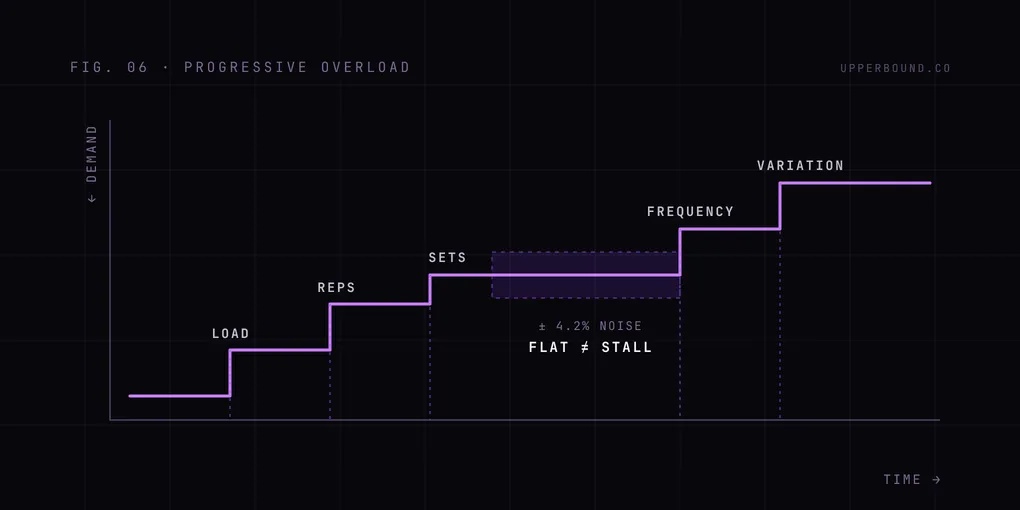
Add more weight than last time, or the program isn’t working. That’s the version of progressive overload most lifters learn first, and it’s not wrong exactly, just incomplete. The idea that actually matters is simpler and a lot less demanding: give a muscle more to do than it’s used to, over time, in whatever form that takes this week. Get that part right, and “add weight every single session or you’re failing” stops being the rule and becomes just one tool you reach for sometimes.
Key Takeaways
- Progressive overload means gradually increasing the demand on a muscle over time, not adding weight every session. The 2026 ACSM position stand is explicit that continued progression is “likely a requirement only for those seeking continued longer term progress” (ACSM Position Stand, 2026).
- You have at least four levers: load, reps and sets, frequency, and exercise variation. A 2022 trial found progressing reps at a fixed load built comparable strength and size to progressing the load itself (PeerJ, 2022).
- A flat week isn’t automatically a stall. 1RM testing has a median day-to-day coefficient of variation of 4.2% across 32 studies (Sports Medicine - Open, 2020), so some weeks just won’t move, and that’s noise, not failure.
What does progressive overload actually mean?
In 2026, the American College of Sports Medicine released its first update to resistance training guidance in seventeen years, and it defines progressive overload plainly: “the need to increase the stimulus (stressor) placed upon the muscle throughout a training program” (Currier et al., ACSM Position Stand, 2026). Notice what isn’t in that sentence: a required cadence. Nothing says every week, every session, or by any fixed percent.
That’s the whole disagreement this post has with the popular version. Overload is the direction training has to net out to over a few months, not a ritual you perform on a schedule. It sits next to the rest of this site’s argument rather than replacing it: autoregulating your weekly volume is the week-to-week navigation, reading sleep, joints, and performance to decide this week’s dose. Progressive overload is the destination those weekly reads are supposed to be steering toward.
The same 2026 position stand goes further than a definition, and this is where “broscience” earns its place in the title. The authors state directly that progression “is likely a requirement only for those seeking continued longer term progress,” not a universal law every lifter has to obey in every phase (ACSM Position Stand, 2026). Overload isn’t church attendance. It’s closer to a savings account: you don’t have to deposit every single day, you have to trend upward over the months that count.
Why does adding weight every week eventually stop working?
Because your top set isn’t a straight line, it’s a noisy one. A 2020 systematic review pooling 32 studies and 1,595 lifters found 1RM testing has good to excellent reliability overall, but the coefficient of variation between sessions still ranged from 0.5 to 12.1 percent, with a median around 4.2 percent (Grgic et al., Sports Medicine - Open, 2020). Even on a normal week, your true strength wobbles inside that band before you factor in a bad night’s sleep or a stressful month at work.
I ran the classic linear-progression programs for a while, the same three I’ve mentioned before on this site (Stronglifts, GSLP, 5/3/1), and for the first several months adding weight every session felt like magic. Then one Tuesday I couldn’t add the plates, and the program had no answer beyond “try again next time.” A rule that only ever points up will always hit a week it can’t cash the check on. That’s not a design flaw you can program around. It’s what noisy data does to a rigid schedule, and it’s exactly the gap the four signals from the autoregulation post exist to close.
What are the actual levers for overload?
Weight is the lever everyone names first. It’s one of at least four, and knowing the others is what keeps you moving once the first one stalls.
Load. The most recognized lever, and the one every fixed program leans on hardest. ACSM’s earlier (2009) guidance put a number on it: roughly a 2 to 10 percent load increase once you can beat your rep target for two sessions running, smaller jumps on isolation work, bigger jumps on big compound lifts. The 2026 update quietly drops the fixed percentage. It backs raising the weight “commensurate with strength gains” as shown by regular testing or an effort scale (ACSM Position Stand, 2026), which is RPE by another name. Even the position stand that invented the round number has moved toward reading the lifter instead of following a script.
Reps and sets. More total work per muscle per week is still overload, and it’s the lever your volume landmarks are built to manage. Add a rep to your top set, or a set to the session, and you’ve raised the demand without touching the bar.
Frequency. Training a muscle twice a week instead of once raises its weekly exposure to the stimulus, inside the same landmark ceiling.
Exercise variation, tempo, and rest. The minor levers. Swapping to a variant that stresses the same muscle from a different angle, slowing the eccentric, or trimming rest between sets, all count when the first two levers have nothing left to give this block.
Should you add reps or add weight first?
Add whichever one you can add cleanly this session, and don’t treat it as a permanent choice. A 2022 controlled trial split 38 trained lifters into two groups over eight weeks: one added load and held reps in the 8 to 12 range, the other held load and added reps. Strength gains slightly favored the load group, by about 2.0 kg on average, and muscle growth slightly favored the reps group, by about 2.8 mm of rectus femoris thickness, but neither difference was statistically decisive (Plotkin et al., PeerJ, 2022).
That’s a real answer, not a shrug. Both progressions work. If your grip or your knees are having an off day but your bar speed is fine, add a rep. If your reps have been sailing past target for two sessions, add the plate. The lever you pick matters a lot less than picking one and tracking whether it actually moved the needle.
How does overload fit with volume landmarks and RPE?
Overload without a ceiling is how you run past your MRV. Overload without a way to price today’s effort is a guess dressed up as a plan. This is exactly where the other two pillars of this loop plug in.
Your MEV, MAV, and MRV set the envelope your rep and set progression has to stay inside. You don’t add sets forever, you add them until you’re bumping into the ceiling that post already lays out. And reps in reserve is how you decide, on any given day, whether the top set can absorb one more rep or one more plate without you guessing.
The evidence on autoregulating that decision is genuinely mixed, and it’s worth saying so plainly rather than picking the study that flatters the thesis. A 2021 meta-analysis found auto-regulation methods outperformed fixed loading overall (effect size 0.64), with the edge biggest in shorter blocks of five to seven weeks and smaller once training stretched past eight (Zhang et al., Frontiers in Physiology, 2021). A separate 2022 review found no significant difference between autoregulated and fixed-load prescriptions for 1RM strength specifically, though autoregulating training volume through velocity-loss thresholds did move the needle: lower thresholds favored strength, higher ones favored size (Hickmott et al., Sports Medicine - Open, 2022).
Read together, that doesn’t prove autoregulation guarantees a bigger number. It means the rigid version isn’t the safe default people assume, and reading RPE alongside your landmarks costs you nothing and occasionally saves a session that a fixed script would have wasted.
Is a stall a plateau, or a signal to back off?
One flat session, or even two, is usually noise, not failure. The reliability numbers above already tell you to expect that. What changes the read is company: a stall that shows up alongside rising joint pain, flat readiness, or motivation that’s cratered is the same four signals from the autoregulation post telling you to hold, not push.
Those two situations call for different fixes. A plain plateau usually means it’s time to reach for a different lever, more reps this block instead of more load, or a frequency bump instead of either. A stall paired with the recovery signals going red usually means the fix isn’t a new lever at all, it’s a planned back-off for a week. And you can’t reliably tell which one you’re looking at without a log of what you actually did, because memory rounds a bad week up to “about the same as always” far more often than a logbook does.
What actually kills progressive overload before biology does?
Not enough recovery, not enough tracking, or changing every dial at once so you can’t tell which one worked. I want to flag this section clearly as opinion built on watching myself and training partners do this, not a set of numbers from a trial.
Ego lifting. Chasing a number by cutting the range of motion or letting form break down isn’t overload, it’s just a smaller exercise wearing a bigger number’s clothes. The muscle never got the extra demand; the weight just got easier to move badly.
Changing everything in the same week. Add load, add a set, and swap the exercise all in one session, and a good week or a bad one both become unreadable. You won’t know what to repeat or what to drop, which quietly defeats the entire point of picking a lever on purpose.
Overriding the signals to force it through. The hardest one. When your numbers stall and your joints, sleep, and motivation are already telling you to back off, pushing the same lever anyway isn’t discipline, it’s ignoring data you asked for and didn’t like the answer to.
Frequently Asked Questions
How much weight should I add each week?
There’s no single correct number. Older ACSM guidance suggested roughly 2 to 10 percent once you can beat your rep target for two sessions, smaller jumps on isolation lifts, bigger jumps on compound ones. The 2026 update moves away from a fixed percentage entirely, favoring increases sized to what regular testing or an effort scale actually shows (ACSM Position Stand, 2026).
Should I increase reps or weight?
Either works. A 2022 trial found comparable strength and hypertrophy outcomes whether lifters progressed load or reps over eight weeks (Plotkin et al., PeerJ, 2022). Pick whichever you can add cleanly that session, and stay consistent enough within a block to tell if it’s working.
What if my numbers stall for a few weeks?
Check for company first. A stall on its own usually just needs a different lever. A stall alongside rising joint pain, flat readiness, or dead motivation is a signal to plan a deload rather than force the same lever through it.
Does progressive overload apply to bodyweight training?
Yes. Reps, tempo, and leverage (single-limb variants, deficits, elevated positions) are your load levers instead of plates. The definition doesn’t change, only which lever you’re pulling.
Is it bad to not progress every single session?
No. 1RM testing carries a median day-to-day variation around 4.2 percent even under good conditions (Grgic et al., Sports Medicine - Open, 2020), and the 2026 ACSM update itself frames continuous progression as something only long-term progress requires, not every workout (ACSM Position Stand, 2026). A flat session most weeks is normal.
The bottom line
Progressive overload is the direction, not a weekly ritual of always adding weight. You’ve got four levers (load, reps and sets, frequency, and the minor ones), a volume ceiling from your landmarks, an RPE dial to price today’s effort, and the same four recovery signals from the hub telling you when to hold instead of push. Run all of that as one loop, measure, adjust, repeat, and the broscience version of overload stops being something you can fail at.
Sources
- Currier et al., American College of Sports Medicine Position Stand, Resistance Training Prescription for Muscle Function, Hypertrophy, and Physical Performance in Healthy Adults: An Overview of Reviews, Medicine & Science in Sports & Exercise, retrieved 2026-07-22, https://pmc.ncbi.nlm.nih.gov/articles/PMC12965823/
- Grgic, Lazinica, Schoenfeld & Pedisic, Test-Retest Reliability of the One-Repetition Maximum (1RM) Strength Assessment: A Systematic Review, Sports Medicine - Open, retrieved 2026-07-22, https://pmc.ncbi.nlm.nih.gov/articles/PMC7367986/
- Zhang et al., Auto-Regulation Method vs. Fixed-Loading Method in Maximum Strength Training for Athletes: A Systematic Review and Meta-Analysis, Frontiers in Physiology, retrieved 2026-07-22, https://pmc.ncbi.nlm.nih.gov/articles/PMC7994759/
- Plotkin et al., Progressive Overload Without Progressing Load? The Effects of Load or Repetition Progression on Muscular Adaptations, PeerJ, retrieved 2026-07-22, https://pmc.ncbi.nlm.nih.gov/articles/PMC9528903/
- Hickmott, Chilibeck, Shaw & Butcher, The Effect of Load and Volume Autoregulation on Muscular Strength and Hypertrophy: A Systematic Review and Meta-Analysis, Sports Medicine - Open, retrieved 2026-07-22, https://pmc.ncbi.nlm.nih.gov/articles/PMC8762534/